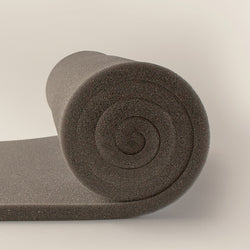
Acoustic & Soundproofing Foam
Fire rated acoustic foam, cut to order in our UK factory.
First, the honest bit: foam absorbs sound, it does not block it
This is the most common and most expensive misunderstanding in acoustics, and it is worth being straight about it before you spend anything.
Acoustic foam absorbs sound energy inside a room. It reduces echo, reverberation, flutter and standing waves. It makes a room sound better — clearer recordings, less boominess on calls.
Acoustic foam does not soundproof. It will not stop your drum kit reaching the neighbours. Blocking sound transmission through a wall requires mass and isolation — dense, heavy, decoupled construction. Foam is light and porous, which is exactly what makes it good at absorption and useless at blocking. If your goal is to stop sound escaping the room, foam alone will not do it, and no thickness of it will.
Which one do you need?
| Product | Fire rating | Use it for |
|---|---|---|
| Acoustic Foam 25A | Crib 5, UL94-HF-1 | Recording studios, rehearsal rooms, home offices, podcast rooms. General room treatment. |
| Fireseal Class 0 | Class 0 · EN 13501-1 B-s1,d0 · UL94 V-0 | Anywhere building fire regulations apply — ductwork, HVAC, plant and generator rooms, commercial fit-outs, marine and MOD applications. |
Crib 5 and Class 0 are not the same thing
Crib 5 (BS 5852 Ignition Source 5) is a furniture fire test. Class 0 is a building regulations rating for the surface spread of flame on walls and ceilings. If you are treating a room as part of a commercial building where Class 0 surfaces are specified, Crib 5 is not sufficient — you need the Fireseal.
Thickness matters more than you think
Thicker foam absorbs more sound, and crucially absorbs lower frequencies that thin foam passes straight through. Our Fireseal is measured at αw 0.30 at 12mm, 0.45 at 25mm, and 0.75 at 75mm — the thickest absorbs roughly two and a half times as much sound energy as the thinnest. If you are fighting bass build-up, go thicker.
See our foam FAQs for more on fire ratings.