
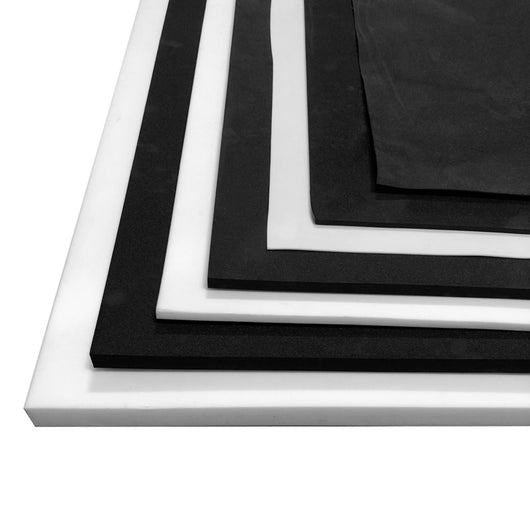

Plastazote LD33 Closed Cell Foam Sheet — Waterproof, Buoyant, Heat Mouldable Polyethylene Foam
Regular price
£33.99
Sale
Plastazote LD33 is a closed cell polyethylene foam from the Zotefoam Azote range — waterproof, buoyant, highly impact resistant, and heat mouldable between 85°C and 140°C. Supplied in 100 x 200cm sheets, 5mm to 50mm thick, in black or white.
Closed cell foam behaves very differently from the open cell polyurethane foams used in upholstery. Its cells are sealed and filled with nitrogen, so water cannot get in. That makes it waterproof, buoyant, and far tougher — it resists incoming force and rebounds, rather than absorbing and staying compressed.
It is the foam used where the thing being protected genuinely matters: medical equipment, camera gear, precision tools, antiques, military hardware. It is also the foam used in orthotics, because it can be heat moulded directly to a patient.
Specifications
| Material | Closed cell polyethylene foam (Plastazote LD33, Zotefoam Azote range) |
|---|---|
| Cell structure | Interlinked closed cells containing nitrogen |
| Water resistance | Waterproof — water cannot enter the cells |
| Buoyancy | Buoyant — suitable for flotation applications |
| Heat mouldable | Yes, between 85°C and 140°C |
| Impact resistance | High — resists force and rebounds |
| Sheet size | 100 x 200cm |
| Thicknesses | 5mm, 10mm, 15mm, 20mm, 25mm, 30mm, 40mm, 50mm |
| Colours | Black · White |
What closed cell foam is for
- Medical splints, braces and orthotics — heat mould it directly to the patient
- Case inserts and foam trays — cut to shape to house tools, cameras or instruments
- Protective packaging for high-value or fragile items
- Flotation aids and swimming pool applications — it is buoyant and waterproof
- Protective sportswear padding
- Marine applications where the foam will get wet
Questions about this foam
What is the difference between closed cell and open cell foam?
Open cell foam (all our upholstery foams) has interconnected cells with air passing between them. It is soft, compressible and absorbent — it soaks up water and stays wet. Closed cell foam has sealed cells. It is firmer, tougher, waterproof and buoyant. You sit on open cell foam; you protect things with closed cell foam.
How do I heat mould it?
Warm it to between 85°C and 140°C, at which point it becomes pliable and can be shaped. This is why it is widely used in orthotics — once warm, it can be applied directly to the area being supported and it will hold that shape as it cools. Take normal care with heated material.
Can I use it near or in water?
Yes — this is one of its main advantages. Because the cells are closed and nitrogen-filled, water cannot travel into the material. It stays buoyant and does not become waterlogged. For upholstered cushions that get wet but need to be soft, our reticulated foam is the better choice, as it lets water drain straight through.
For the full explanation of density, firmness and fire ratings, see our foam FAQs. To compare every grade side by side, see our foam grade comparison.
Cut to order in our own UK factory. Next working day delivery is available to most of the UK — see our delivery page for timings to your area.