
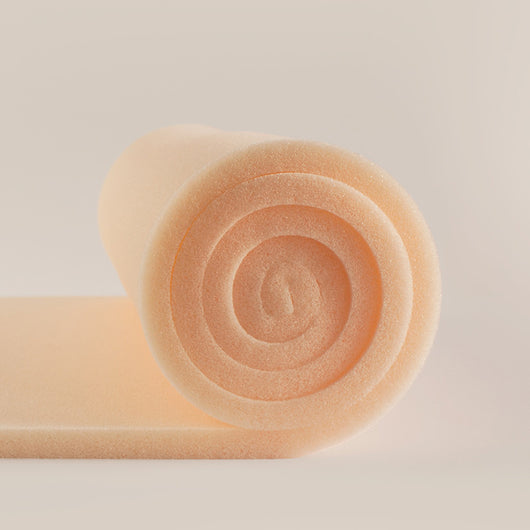

Soft Upholstery Foam Sheet 39S — 39kg/m³, 120N Soft, Crib 5 (V39 120 / RX39/120)
Regular price
£57.99
Sale
A soft, luxury-grade high density foam sheet — 39 kg/m³ density, 120 Newton firmness, Crib 5 fire rated, cut in the UK. Intended for sofa back cushions and headboards, not for seat cushions.
This is a soft foam at a high density, which is an unusual and useful combination: it feels yielding, but the high density means it holds up over time rather than collapsing like a cheap soft foam would.
Please note: we do not recommend this grade for seat cushions. At 120 Newtons it is too soft to support sitting weight, and you will sink through it. For seats, use a medium or hard grade.
Specifications
| Foam grade | 39S (V39 120 – RX39/120) |
|---|---|
| Density | 39 kg/m³ (high density) |
| Firmness | 120 Newtons (ILD at 40% compression) — soft feel |
| Fire behaviour | Crib 5 (BS 5852 Ignition Source 5) |
| Colour | Orange |
| Material | Polyurethane foam |
| Sheet sizes | 230 x 200cm (88" x 78.7") · 230 x 100cm (88" x 39.3") |
| Thicknesses | 1/2", 1", 1.5", 2", 3", 4" |
| Manufactured | United Kingdom |
What this foam is for
- Sofa back cushions — the main use. Soft is what you want behind you.
- Headboards — 1"–2" is typical.
- Scatter and decorative cushions
- Not seat cushions — see the 35M, 41M, 33H, 39H or 42H instead.
Questions about this foam
This is your densest upholstery foam but also one of the softest. How?
This product is the clearest proof that density and firmness are different properties. Density (39 kg/m³) is how much material is in the foam — it predicts durability. Firmness (120N) is how much force it takes to compress it — it predicts feel. Our 33H is less dense at 33 kg/m³ but far firmer at 190N. Buying "high density" does not get you a firm foam.
Why can’t I use this for seat cushions?
At 120N it will not support sitting weight. You would sink through and feel the frame. A soft foam behind your back is comfortable; a soft foam under your weight is not. For seats, choose 125N or above.
Will my new foam soften?
Yes, slightly. All polyurethane foam softens by around 10–15% in the first few weeks of use as the cell structure settles. This is normal and is not a fault. A faint manufacturing odour on new foam is also normal and fades over the first few weeks.
For the full explanation of density, firmness and fire ratings, see our foam FAQs. To compare every grade side by side, see our foam grade comparison.
Cut to order in our own UK factory. Next working day delivery is available to most of the UK — see our delivery page for timings to your area.